
If you’ve been paying attention to tech news over the last decade, you’ve probably heard that quantum computing is going to change everything, cure all diseases, and possibly break the internet. You’ve also probably heard the running joke that it’s always “ten years away.”
Well, welcome to 2026. The punchline is finally wearing thin.
We are officially transitioning from clunky, error-prone science experiments to early fault-tolerant systems that actually do useful work. But if the phrase “quantum computing” still makes your eyes glaze over, you aren’t alone. This guide is your jargon-free ticket to understanding what is quantum computing and why it matters right now. No physics PhD required. Let’s break down quantum computing for beginners.
What is Quantum Computing? (The Basics)
At its core, quantum computing explained simply is a completely different way of processing information.
Imagine you’re in a massive library looking for one specific sentence in one specific book. A classical computer is like an incredibly fast librarian who checks every single book, one by one, until they find it. A quantum computer? That librarian clones themselves, reads every book in the library at the exact same time, and hands you the answer before you even finish asking the question.
That’s the fundamental difference in how quantum computers work. They don’t just calculate faster; they calculate differently, allowing them to solve specific types of complex problems that would take a traditional supercomputer millions of years to crack.
Classical Bits vs. Quantum Qubits
To get why this happens, we need to look at the building blocks. Your laptop, your phone, and the server hosting this article all run on classical bits. A bit is a tiny switch that is either off (0) or on (1). It’s binary. It’s rigid.
Enter the qubit (short for quantum bit). When comparing qubits vs bits, the classical bit is a coin sitting flat on a table—it’s strictly heads or tails. A qubit is that same coin, but it’s spinning in the air. While it’s spinning, it’s not just heads or tails; it’s a blur of both at the same time. This ability to hold multiple states at once is what is a qubit all about, and it’s the fundamental trick that gives quantum machines their mind-bending processing power.
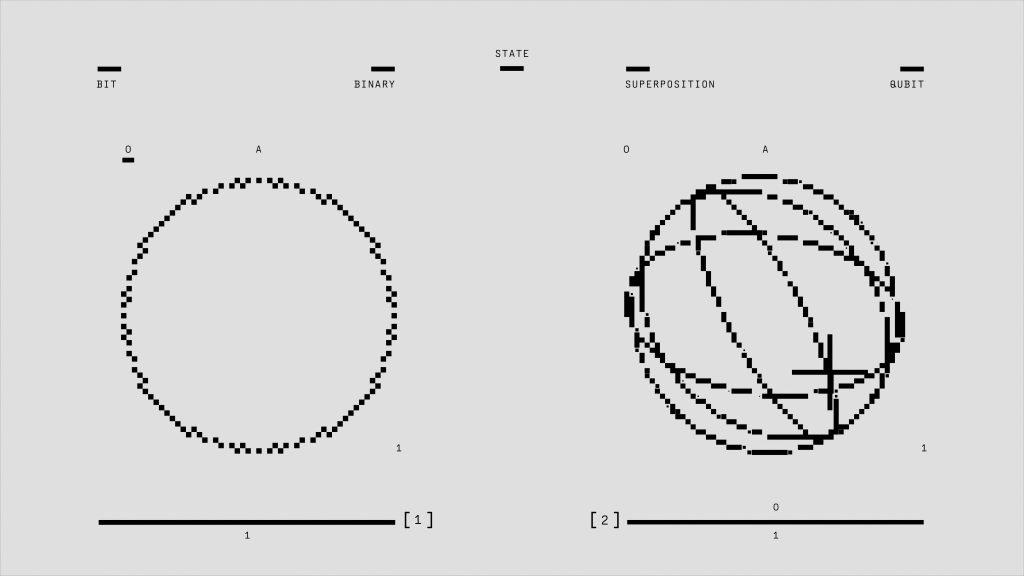
by Google DeepMind via pexels
The Hardware: How Do We Make a Qubit?
So, how do engineers actually build a spinning coin out of metal and code? It’s not easy, and tech giants are currently in a massive hardware bake-off. Here are the three main ways we’re making qubits today:
- Superconducting Circuits: This is the approach championed by heavyweights like IBM and Google. They use tiny loops of metal cooled to near absolute zero so electricity can flow without resistance. Think of it as building a microscopic, super-chilled racetrack for electrons.
- Trapped Ions: Companies like IonQ and Quantinuum use individual, electrically charged atoms (ions) suspended in a vacuum by electromagnetic fields. Lasers are then used to poke and prod them into computing. It’s essentially using light to play billiards with single atoms.
- Neutral Atoms: The breakout star of the 2026 hardware scene. Instead of charged ions, these systems use uncharged atoms held in place by highly focused lasers (often called optical tweezers). They are highly scalable and can be packed tightly together, making them a massive favorite for next-gen processors.
You don’t need to know the thermodynamics behind them. Just know that building a qubit requires tricking nature into behaving perfectly in highly controlled, extreme environments.
The 3 Pillars of Quantum Mechanics (Made Simple)
If you thought building a super-chilled racetrack for electrons was weird, buckle up. The actual physics powering these machines is where things get truly bizarre. But don’t worry, we’re keeping this strictly to quantum mechanics for beginners.
To understand why a quantum computer is so powerful, you just need to understand three quirky rules of the subatomic universe: superposition, entanglement, and interference.
1. Superposition: The Power of “Both”
We briefly touched on the spinning coin analogy for qubits vs bits in the last section, but let’s look at why superposition is a computational superpower.
Imagine you are trying to find your way out of a massive, complicated corn maze. A classical computer acts like a really fast runner. It sprints down a path, hits a dead end, runs all the way back to the start, and tries the next path. It eventually finds the exit, but it takes a lot of time and shoe leather.
A quantum computer, thanks to superposition, acts like water flooding the maze. It flows down every single path simultaneously. It doesn’t have to check them one by one; it explores the entire maze all at once. This ability for a qubit to exist in a “blur” of multiple states (both 0 and 1) at the exact same time is what allows these machines to process a mind-boggling number of possibilities in a single operation.
2. Quantum Entanglement: Spooky Connection
Albert Einstein famously hated this concept, calling it “spooky action at a distance.” But today, quantum entanglement is the secret sauce that lets quantum computers scale up their power.
So, what is quantum entanglement in simple terms? Imagine you have a pair of magic dice. You give one to a friend who flies to Tokyo, and you keep the other in New York. You roll your die in New York and get a six. Instantly, no matter the distance, your friend’s die in Tokyo will also land on a six.
In the quantum world, when qubits become entangled, they lose their individual identities and become a single, linked system. If you change the state of one qubit, its entangled partner reacts instantly. This means that if you add just one extra entangled qubit to your system, your computing power doesn’t just double—it scales exponentially. It’s the difference between adding one more gear to a bicycle and adding an entirely new engine.
3. Interference: Cancelling the Noise
Here is the catch with superposition: if your quantum computer explores every path in the maze at the same time, how do you actually read the correct answer at the end? If you just look at the spinning coin, it collapses back into a random 0 or 1.
This is where interference saves the day. Think of it like a pair of high-end, noise-canceling headphones. Those headphones listen to the annoying hum of an airplane engine and generate an exact opposite sound wave to cancel it out, leaving you with sweet silence.
Quantum algorithms use interference in the exact same way. They are programmed to create “destructive interference” for the wrong answers (canceling them out so they disappear) and “constructive interference” for the right answer (amplifying it so it’s the only one left standing when you finally measure the system).
Quantum Advantage vs. Quantum Supremacy
If you follow tech news, you’ve likely seen the media throw around the words “supremacy” and “advantage” like they are interchangeable. They aren’t. Understanding the difference between quantum advantage vs supremacy is key to separating the science fiction from the actual 2026 business reality.
Quantum Supremacy (sometimes called quantum primacy) is a historical milestone. It simply means a quantum computer did something—anything—faster than a classical supercomputer. Back in 2019, Google claimed supremacy when their processor solved a highly specific, totally useless random-number math problem in 200 seconds that would have taken a classical supercomputer 10,000 years. It was a great proof-of-concept, but entirely impractical. Think of it like building a car that can drive 400 mph, but it only has three wheels and can only drive in a straight line on a salt flat.
Quantum Advantage (and the more recent term, quantum utility), is the holy grail. This is the point where a quantum computer can do something commercially useful—like discovering a new battery material or optimizing a global shipping route—faster, cheaper, or more efficiently than a classical computer. We don’t care about useless math problems anymore; we care about real-world ROI.
The 2026 Landscape: Enter the Era of “Logical Qubits”
For the last few years, the industry was stuck in what physicists called the NISQ era (Noisy Intermediate-Scale Quantum). The problem? Qubits are incredibly fragile. A slight change in temperature or a stray cosmic ray causes “decoherence,” making the qubit lose its data and spit out errors.
But here is the massive shift defining 2026: we are finally moving past the noise through Quantum Error Correction (QEC).
To understand logical qubits explained simply, think of a physical qubit as a highly talented but easily distracted intern. If you ask them to do complex math, a loud noise outside will make them forget what they were doing and give you a wrong answer.
To fix this, engineers group dozens or even hundreds of these physical “interns” together to act as a single logical qubit. They constantly check each other’s work. If one physical qubit makes an error due to environmental noise, the rest of the group catches the mistake and corrects it on the fly without losing the data. This transition to stable, error-corrected logical qubits is exactly what is pushing the industry out of the laboratory and into the era of true quantum advantage.
Real-World Quantum Computing Applications in 2026
Alright, enough theory. Let’s talk about the real world. You aren’t going to use a quantum computer to stream Netflix or check your email. Classical computers are already perfect at that. Instead, quantum computing applications are reserved for the absolute nightmares of mathematics—the problems that make traditional supercomputers sweat, crash, or take a million years to solve.
Here are the quantum computing use cases where the technology is actually moving the needle right now.
Cybersecurity & Post-Quantum Cryptography (PQC)
Let’s address the elephant in the server room. The biggest fear surrounding this tech is that a powerful quantum machine will run something called Shor’s algorithm, effortlessly cracking the RSA encryption that currently protects everything from your bank account to state secrets. It’s like a quantum computer is a master key that can eventually pick every digital lock on Earth.
Because of this looming threat, 2026 has seen a massive, urgent global migration to Post-Quantum Cryptography (PQC). Tech giants and governments are currently swapping out old digital locks for new, math-heavy cryptographic standards approved by NIST that even quantum computers can’t pick.
This brings up a massive People Also Ask question: Will quantum computers break Bitcoin?
The short answer is: Eventually, a powerful enough machine could crack the cryptography securing current blockchain networks. The long answer is that the crypto industry knows this is coming. Long before “Q-Day” (the day a quantum computer breaks encryption), blockchains will hard-fork and upgrade to quantum-resistant algorithms. Your digital wallet won’t be emptied by a quantum hacker; the network will simply change the locks before they get there.
Drug Discovery & Materials Science
This is arguably the most exciting application. Right now, discovering a new drug or a better EV battery relies heavily on trial and error in a physical lab. Why? Because classical computers are terrible at simulating chemistry.
Trying to simulate a complex molecule on a classical computer is like trying to figure out how a bumpy airplane flight feels by just staring at a paper blueprint. But molecules are quantum systems. They obey the weird rules of quantum mechanics. By using a quantum computer, scientists can simulate molecular interactions natively. It’s the equivalent of actually flying the plane. This is drastically accelerating the timeline for life-saving pharmaceuticals and hyper-efficient solar panels.
Financial Modeling & Logistics Optimization
Imagine you are a travel agent trying to book flights for 10,000 people, but you have to ensure no two people are on the same flight, everyone gets to their destination on time, and you spend the absolute minimum amount of money. A classical computer chokes on that many variables.
Quantum algorithms, however, eat optimization problems for breakfast. Wall Street is using them for portfolio optimization and real-time risk analysis, while global shipping companies are using them to route thousands of cargo ships around weather patterns and port delays in real-time.
Quantum Machine Learning (QML)
We are all familiar with the AI boom, but training massive AI models requires staggering amounts of classical computing power and electricity. Enter Quantum Machine Learning. By using “quantum kernels,” developers can map data into highly complex quantum states, allowing AI to spot hidden patterns in massive datasets much faster. It’s not replacing your standard AI; it’s acting as a high-octane turbocharger for specific, highly complex training tasks.
The Challenges: Why Don’t We Have Quantum Laptops?
With all this world-changing potential, you might be wondering: If this tech is so great, why am I writing this on a boring, classical laptop?
Why can’t you buy a sleek, quantum-powered MacBook at your local electronics store? The truth is, building and maintaining these machines is an absolute engineering nightmare. Here are the primary quantum computing challenges keeping them locked in heavily guarded laboratories.
Decoherence and the Need for Extreme Cold
Remember how we said a qubit is like a spinning coin? Well, imagine trying to keep that coin spinning perfectly while a bunch of toddlers are running around the room, screaming and throwing toys.
In the quantum world, those toddlers are environmental noise: stray Wi-Fi signals, microscopic temperature fluctuations, and cosmic rays. When a qubit gets bumped by this noise, it loses its quantum state and spits out garbage data. This incredibly frustrating phenomenon is called quantum decoherence.
To stop the “toddlers,” we have to isolate the qubits entirely. For superconducting quantum computers, this means putting the chips inside massive dilution refrigerators. These fridge units pump out liquid helium to cool the processors down to a fraction of a degree above absolute zero (around -460°F). To put that in perspective, the inside of a quantum computer is significantly colder than the vacuum of deep space. You definitely don’t want that sitting on your lap while you browse Reddit.
The Talent Gap
The hardware is incredibly tough to build, but the software is just as hard to write. You can’t just take a standard Python developer and tell them to write a quantum app. Coding for these machines requires a fundamental rewiring of how you think about logic and probability.
Right now, the industry is facing a massive talent gap. We have the equivalent of Formula 1 race cars, but a severe shortage of drivers who actually know how to drive them. Universities and tech companies are scrambling to train a new generation of “quantum-literate” software engineers and physicists, but it’s going to take years to build a workforce large enough to meet the 2026 demand.
How to Get Started with Quantum Computing (No PhD Required)
So, you can’t buy one for your desk, and building one requires a degree in quantum physics and a massive budget for liquid helium. Does that mean you just have to sit on the sidelines and watch the tech giants have all the fun?
Absolutely not. You don’t need to know how to build a combustion engine from scratch to drive a car. The exact same logic applies to quantum computing programming. You can write code for these machines today, right from your standard laptop, without needing a doctorate. Here is how you learn quantum computing and get your hands dirty.
Cloud Quantum Platforms
Instead of buying a multi-million-dollar machine, you just rent time on someone else’s.
Tech giants have hooked up their massive, super-cooled quantum processors to the internet. Through platforms like IBM Quantum, AWS Braket, and Azure Quantum, you can write a script on your laptop, hit “run,” and send that job over the cloud to a real, physical quantum computer sitting in a lab in New York or Europe.
Many of these platforms offer a “simulator” mode, which lets you test your code on a classical computer for free to make sure it works. Once you’re ready, you can pay a few cents (or use free tier credits) to run your exact code on actual quantum hardware. It’s the ultimate “hello world” flex.
Beginner Frameworks: Qiskit and Cirq
To actually talk to these cloud-based quantum computers, you need a translator. Fortunately, the industry has standardized around a few incredibly user-friendly, open-source frameworks.
If you already know a little bit of Python, you are halfway there.
- Qiskit: Created by IBM, this is arguably the most popular open-source SDK out there. It has a massive community, endless free tutorials, and even offers a recognized certification path if you want to put it on your resume.
- Cirq: Google’s answer to Qiskit. It’s highly optimized for designing quantum algorithms and is heavily used by researchers testing out new ideas for near-term quantum processors.
You don’t need to memorize complex physics equations to use these. You just use Python to build “quantum circuits”—essentially a series of logic gates that tell the qubits how to spin, entangle, and interfere. If you can write a basic Python script, you can build a quantum circuit this weekend.
Frequently Asked Questions (FAQ)
(Webmaster Note: Please wrap the following Q&A section in FAQPage JSON-LD schema to capture rich snippets on the search engine results page.)
Can I buy a quantum computer for my home?
Nope. Unless you have a few million dollars lying around, a dedicated industrial power supply, and a massive dilution refrigerator to keep your living room at -460°F, you can’t have one. For the foreseeable future, quantum computers will remain in specialized data centers, and everyday users will access them exclusively via the cloud.
Will quantum computers replace classical computers?
Not a chance. They are highly specialized tools, not everyday replacements. Think of it like transportation: you wouldn’t use a massive commercial cargo ship to cross a swimming pool, and you wouldn’t use a jet ski to cross the Atlantic Ocean.
Classical computers are your jet skis and sedans—they are incredibly fast and efficient at everyday tasks like loading web pages, playing video games, and running spreadsheets. Quantum computers are the cargo ships. You only bring them out when you need to haul a massive, overwhelmingly complex mathematical load that a normal vehicle simply can’t handle. They will always work together, not against each other.
Is quantum computing just a hype cycle?
It’s easy to be skeptical. For the last decade, the industry was guilty of overpromising and underdelivering, leading to a lot of “vaporware” accusations. But the conversation has drastically shifted in 2025 and 2026.
The recent, verifiable breakthroughs in Quantum Error Correction—specifically the ability to create stable “logical qubits”—prove that this isn’t just a hype cycle anymore. We have moved past the “proving it’s physically possible” phase and are now deep into the engineering phase. The timeline might still be long, but the destination is now guaranteed.
Conclusion: Preparing for the Quantum Future
Quantum computing is no longer just a wild thought experiment for physicists; it’s an emerging engineering discipline that is actively reshaping the boundaries of what’s possible.
If you’re a business leader, your homework for 2026 is clear: start auditing your cybersecurity posture. The migration to Post-Quantum Cryptography isn’t a panic-induced scramble for tomorrow; it’s a strategic necessity you need to be planning for today.
If you’re a developer, student, or just a tech enthusiast, the barrier to entry has never been lower. Fire up a Jupyter Notebook, install Qiskit, and start playing with qubits. The best way to prepare for the quantum future is to stop treating it like magic and start treating it like code.